
Persistent Silence: Proposal
We normally use the term Silence in reference to sound, often to explain a lack of, or inactivity, in sound. If we were to think of silence with regards to the human mind and consciousness, this could translate into finding Silence in the mind at rest.
I plan to explore the idea of abstract images when the mind is at rest, producing an installation that represents a specific subconscious image during the moments before sleep. The piece will consist of a series of paintings and an animation that will explore the links between memory and physical representation.
When I was younger, I sometimes pictured a moving white image as I lay in bed. It was a white/grey surface that changed from rough and raggedy, to smooth.
I hope to transform this internal image into an external representation, making it open to interpretation from an audience. The work will be presented in the form of a series of abstract paintings representing the white surface in the image. My process of working will be key to the piece and I will allow a good deal of experimentation into colour and mark-making before selecting each painting. To accompany this, a monitor will loop a simple animation of the series of paintings, each image merging into another, to convey the movement of the white surface.
I view the series of paintings as an initial exploration into forming a representation of my subconscious memory. As a result, the concluding animation will convey the memory itself. I am interested in recreating the sense of ambiguity that I feel when remembering this abstract image of my childhood, in turn I aim to draw the audience into my subconscious.
Andrée Latham
Monday, 23 February 2009

Exhibition proposal piece
‘Persistent silence’
Persistent 1 lasting or enduring tenaciously 2 constantly repeated or continued.
Silence 1 absence of sound 2 avoidance or absence of speaking or making a sound.
It is said that the only way to experience complete silence is upon death. My experience of silence has been a fleeting one- silence doesn’t seem persistent to me. When I first questioned silence I thought of that moment when there’s nothing in the air and you have to strain your ears to grasp any hint of a sound and usually one is found before long. We seem to be surrounded by noise. In the city there is always the constant buzz of life, in the countryside there are all the sounds of nature and even when you’re somewhere seemingly still and silent, like the desert, you’re still accompanied by the sound of your breathing.
I’m interested in trying to create and experience persistent silence, if it’s possible. This silent moment prolonged and intensified.
In my own work I’m currently engaging in turning internal memories and feelings into external images. For this project I want to experiment with a somewhat similar process. I want to engage in the experience of persistent silence. I intend to do this by using earplugs in a quiet place, at the dead of night, for a relatively long period of time. Whilst in this quite zone I intend to create visual images of this experience and the feeling that manifests within myself. I’m interested in using paint as my medium to recreate the feeling of my experience.
My reaction to this process will determine how many works I will create. I’m not going to allow my self to start painting until one hour has past and the silence has been felt. I will then start a work every hour on the hour for three hours, to mark the passing of this silent time. More paintings may be made if fragmentation or multiple feelings occur within a short space of time, it might be necessary to create many works to demonstrate all the angles. These works may overlap in the making. I intend to work on large paper or canvas as an open place of expression to allow the works to have physical involvement.
The interpretation of avoiding speaking and making noise will be utilised in my experiment by minimising my movement in my allocated space. I’m also interested in the possibility that this outward experience of persistent silence may create inner silence or peace. Alternatively, it may be a difficult experience, a deafening one; it may become noisier inside in reaction to this forced external silence.
The paintings will be the subjective evidence of this experiment and will hopefully portray the manifestation of persistent silence.
Brianna Bryson-Haynes
‘Persistent silence’
Persistent 1 lasting or enduring tenaciously 2 constantly repeated or continued.
Silence 1 absence of sound 2 avoidance or absence of speaking or making a sound.
It is said that the only way to experience complete silence is upon death. My experience of silence has been a fleeting one- silence doesn’t seem persistent to me. When I first questioned silence I thought of that moment when there’s nothing in the air and you have to strain your ears to grasp any hint of a sound and usually one is found before long. We seem to be surrounded by noise. In the city there is always the constant buzz of life, in the countryside there are all the sounds of nature and even when you’re somewhere seemingly still and silent, like the desert, you’re still accompanied by the sound of your breathing.
I’m interested in trying to create and experience persistent silence, if it’s possible. This silent moment prolonged and intensified.
In my own work I’m currently engaging in turning internal memories and feelings into external images. For this project I want to experiment with a somewhat similar process. I want to engage in the experience of persistent silence. I intend to do this by using earplugs in a quiet place, at the dead of night, for a relatively long period of time. Whilst in this quite zone I intend to create visual images of this experience and the feeling that manifests within myself. I’m interested in using paint as my medium to recreate the feeling of my experience.
My reaction to this process will determine how many works I will create. I’m not going to allow my self to start painting until one hour has past and the silence has been felt. I will then start a work every hour on the hour for three hours, to mark the passing of this silent time. More paintings may be made if fragmentation or multiple feelings occur within a short space of time, it might be necessary to create many works to demonstrate all the angles. These works may overlap in the making. I intend to work on large paper or canvas as an open place of expression to allow the works to have physical involvement.
The interpretation of avoiding speaking and making noise will be utilised in my experiment by minimising my movement in my allocated space. I’m also interested in the possibility that this outward experience of persistent silence may create inner silence or peace. Alternatively, it may be a difficult experience, a deafening one; it may become noisier inside in reaction to this forced external silence.
The paintings will be the subjective evidence of this experiment and will hopefully portray the manifestation of persistent silence.
Brianna Bryson-Haynes
'Persistent Silence' Proposal
After reading the brief on persistent silence, I began thinking about the audience participation within the gallery space. Is silence necessary for an audience? Is noise or broken silence disruptive or can it help the audience engage with the work?
Pondering the need for silence or the lack of, interrelating to the audience’s experience, I began to research the Stanley Picker Gallery space.
My initial idea was to alter the gallery space, perhaps shifting the height of the ceiling, therefore controlling sound waves, echoing etc and enhancing any sounds (other artworks and the audience’s footsteps etc.
I then began investigating how to remove sound, and how difficult it would be to create an anechoic chamber, a space where sound is instantly absorbed. I quite enjoy the idea that a sound recording device could be placed into a vacuum, where sound cannot exist and therefore become dysfunctional.
After researching non-visual art in gallery spaces Tue Greenfort’s work titled ‘Exceeding 2 Degrees’ had a strong impact on me, and reassured my concerns in making conceptual work.
Greenfort raised the temperature of the air conditioning in the Sharjah Art Museum by two degrees for the duration of the Biennial. He taped clear plastic across the opening of his exhibition space, creating a bubble that appeared to inhale and exhale with the pressure of the museum’s air conditioning vents. . The visual aesthetic of the plastic sheeting prepares the audience for the work and I feel that this makes the audience more aware of a change within the space and therefore takes the subtlety of the piece away.
I propose to change the gallery space in a way that will be subtle yet immediately noticeable to the audience, using the existing features in the space. This change will also be non-visual, but rely heavily on the audience’s other senses. I’m not sure yet if this change will be pointed out to the audience, or if it will rely on their own awareness.
I intend to also exhibit a sound piece that cannot be heard, as it will be in a vacuum. The sound piece playing will be a song by New Order, titled ‘Your Silent Face’
“Sound formed in a vacuum may seem a waste of time, it's always been just the same, no hearing or breathing, no movement no lyrics, just nothing”
By Kat Johnston
Pondering the need for silence or the lack of, interrelating to the audience’s experience, I began to research the Stanley Picker Gallery space.
My initial idea was to alter the gallery space, perhaps shifting the height of the ceiling, therefore controlling sound waves, echoing etc and enhancing any sounds (other artworks and the audience’s footsteps etc.
I then began investigating how to remove sound, and how difficult it would be to create an anechoic chamber, a space where sound is instantly absorbed. I quite enjoy the idea that a sound recording device could be placed into a vacuum, where sound cannot exist and therefore become dysfunctional.
After researching non-visual art in gallery spaces Tue Greenfort’s work titled ‘Exceeding 2 Degrees’ had a strong impact on me, and reassured my concerns in making conceptual work.
Greenfort raised the temperature of the air conditioning in the Sharjah Art Museum by two degrees for the duration of the Biennial. He taped clear plastic across the opening of his exhibition space, creating a bubble that appeared to inhale and exhale with the pressure of the museum’s air conditioning vents. . The visual aesthetic of the plastic sheeting prepares the audience for the work and I feel that this makes the audience more aware of a change within the space and therefore takes the subtlety of the piece away.
I propose to change the gallery space in a way that will be subtle yet immediately noticeable to the audience, using the existing features in the space. This change will also be non-visual, but rely heavily on the audience’s other senses. I’m not sure yet if this change will be pointed out to the audience, or if it will rely on their own awareness.
I intend to also exhibit a sound piece that cannot be heard, as it will be in a vacuum. The sound piece playing will be a song by New Order, titled ‘Your Silent Face’
“Sound formed in a vacuum may seem a waste of time, it's always been just the same, no hearing or breathing, no movement no lyrics, just nothing”
By Kat Johnston
'Persistent Silence' Proposal
My practice to present has been an attempt to describe the vastness of the world/universe we live in whilst retaining the scale of these enormities. Most of my works take on a simplicity of gesture or technique. These are certainly themes I want to bring forward into this body of work.
With regards to the title of ‘Persistent Silence’ I want to make work that somehow negotiates the very nature of sound. We live in a paradox whereby true silence can only be achieved through death and is therefore never experienced. To attempt to confront silence itself would appear to be a losing battle. So this title for me becomes about sound, the ever presence of it and its relationship to us.
The first pieces I am proposing for Stanley Picker’s Studio 1 space deal with the nature of sound waves and the actual space the viewer finds themselves in. I want to use the dimensions of the studio and play back a frequency of sound that has the same wavelength as the particular dimension. Say the studio is 7m x 4m then on the 7m wall headphones would be playing constant sound with an audio frequency of 49Hz and the other wall would have a frequency of 85.75Hz. These pieces would play on the viewer’s experience of the space whilst referencing the persistent nature of sound. The headphones would offer hope to the viewer that silence is possible by their removal yet this act would simply make other sound audible. 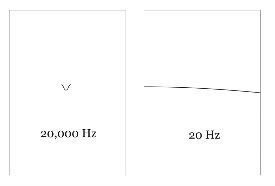
Non-exact versions of the wavelengths at the two ends of our hearing range.
Other work I am considering involves making sound visual. Ideas include digitally drawing the wavelengths of 20Hz and 20,000Hz (average human’s hearing range) to scale and taking A4 segments (see above). A third element could be the drawing of a 344 metre line on A4 paper to illustrate the distance speed travels in one second to scale. These pieces would retain the simplicity of gesture whilst describing sound in its vastness to some sort of comprehendible scale.
All works remain flexible to change depending on co-existing works and general schematics of the space.
By Michael Farrell
'Persistent Silence' Proposal
Title: Persistent Silence
Space: Stanley Picker Gallery.
Brief: Very loose brief but the narrative/pieces and space must to a certain extent examine themes of persistent/broken silence and how they inter relate to the viewers' experience.
In the discussions I have had with the other members of our collective, I have gathered that they intend to be making work about silence, and the concepts of having no sound.
To break this up, I propose to make visitors to the show change their shoes into tap shoes, so as to contradict all the other work in the space.
When only one or two people are viewing the work, the sound may not be too distracting, but I want to gage peoples reactions to the noise particularly at the private view when there are lots of people, considering the audience are likely to be expecting a peaceful space and calming work.
As much as I want to do this to have a juxtaposition with the other work, silence can also be stressful and awkward, and the added noise will hopefully break that, and break the tension of a gallery environment.
Eloise Bailey.
Space: Stanley Picker Gallery.
Brief: Very loose brief but the narrative/pieces and space must to a certain extent examine themes of persistent/broken silence and how they inter relate to the viewers' experience.
In the discussions I have had with the other members of our collective, I have gathered that they intend to be making work about silence, and the concepts of having no sound.
To break this up, I propose to make visitors to the show change their shoes into tap shoes, so as to contradict all the other work in the space.
When only one or two people are viewing the work, the sound may not be too distracting, but I want to gage peoples reactions to the noise particularly at the private view when there are lots of people, considering the audience are likely to be expecting a peaceful space and calming work.
As much as I want to do this to have a juxtaposition with the other work, silence can also be stressful and awkward, and the added noise will hopefully break that, and break the tension of a gallery environment.
Eloise Bailey.
'Persistent Silence' Proposal
For myself I consider the theme of persistent silence a chance for my thoughts to flow. However when trying to sleep i often begin to over-think, and my brain is not allowed to switch off. My body then feels unable to relax and the persistent silence of the early hours make me uncomfortable. A solution i have found is to play an audiobook or a film that i have seen many times and know the words to. This allows my mind to focus on one thing and gradually become comforted by a constant. I feel that silence can often be uncomfortable especially in a gallery or library where one is supposed to maintain silence you are suddenly conscious of any little movement you make as though to make sure you don't create a loud noise. The persistent silence is daunting. I therefore propose to intervene the awkward and distracting persistent silence of the gallery atmosphere and create a comforting place within the space.
I intend to use sound as installation by placing audio books within pillows, played at a low level. I feel this is vital in order to gain an interactive element to my piece, as the audience will have to get close to the work in order to hear the sound. I also am considerate of the possibility that loud sound may distract or counteract another artists' work within the space. Like the 'Straylight Cavern' I would like my piece to not only be interactive but also tactile. Like the work in the cell gallery space that could be touched, such as the giant dome space that contained the work, the pillows will be able to be picked up and moved about the space again to enhance an interactive feel to the work. I decided to use pillows to play on the idea of comforting sound. I also find an interesting contrast between sound and the 'muffling' quality of pillows, as material absorbs sound.
by Pippa Sweeney
I intend to use sound as installation by placing audio books within pillows, played at a low level. I feel this is vital in order to gain an interactive element to my piece, as the audience will have to get close to the work in order to hear the sound. I also am considerate of the possibility that loud sound may distract or counteract another artists' work within the space. Like the 'Straylight Cavern' I would like my piece to not only be interactive but also tactile. Like the work in the cell gallery space that could be touched, such as the giant dome space that contained the work, the pillows will be able to be picked up and moved about the space again to enhance an interactive feel to the work. I decided to use pillows to play on the idea of comforting sound. I also find an interesting contrast between sound and the 'muffling' quality of pillows, as material absorbs sound.
by Pippa Sweeney
Exhibition Piece Proposal
...An artist walked on stage and sat at a piano in front of a massive expectant ordinance. He remained sat looking at the keys not playing for a long stretch of time before standing up and walking off the stage. The music was the ordinances growing impatient. Silence or not?...
This piece has been designed especially to adhere to the specifications laid down by a chosen individual. This piece will also be exhibited along side the work of five others which is a factor to take into consideration.
I propose a piece of work to be projected onto one of the galleries walls. A blank piece of sheet music blown out of all proportion at about a meter across. Representing silence this image is flashing, two flashes per second to represent persistence. There is then a break of ten seconds before the flashing starts up again at a faster pace. The flashing keeps that up at that pace for two minutes before another break of ten seconds then returning to the original flashing speed.
I propose to borrow the overhead projector either from the university, and the video work will be created using final cut pro. The video itself will take roughly a week to get fully prepared for exhibition. The overhead projector will depend on availability.
The affect intended by this piece is to slightly stress out the visitor. By creating a factor that affects one of the senses in a way the visitor cannot control should aggravate that sense, this will be done by the persistence of the flashing. Ideally the gallery should be slightly dimmed to show of the flashing to its full affect. Where ever the visitor looks within the exhibition the flashing will always be there in the back of their perception, affecting the thought processes.
The flashing represents an element of persistence. It effects the way you think, the more you try to ignore it the more it annoys you. You start to think of nothing else. When there is a break in the persistence you calm down and thank god the annoyance has gone away. only to have it start up again at a faster pace ten seconds later.
There is an element of research within this piece and I intend to ask visitors wether the flashing did effect them in any way. My current hypothesis is that the visitors that rate themselves as relaxed individuals will not be as affected by the flashing, and that the visitors that rate their stress level as high or mood that day as bad will be far more aggravated as the persistent flashing...
...an element they have no control over.
Danielle Birkhead
This piece has been designed especially to adhere to the specifications laid down by a chosen individual. This piece will also be exhibited along side the work of five others which is a factor to take into consideration.
I propose a piece of work to be projected onto one of the galleries walls. A blank piece of sheet music blown out of all proportion at about a meter across. Representing silence this image is flashing, two flashes per second to represent persistence. There is then a break of ten seconds before the flashing starts up again at a faster pace. The flashing keeps that up at that pace for two minutes before another break of ten seconds then returning to the original flashing speed.
I propose to borrow the overhead projector either from the university, and the video work will be created using final cut pro. The video itself will take roughly a week to get fully prepared for exhibition. The overhead projector will depend on availability.
The affect intended by this piece is to slightly stress out the visitor. By creating a factor that affects one of the senses in a way the visitor cannot control should aggravate that sense, this will be done by the persistence of the flashing. Ideally the gallery should be slightly dimmed to show of the flashing to its full affect. Where ever the visitor looks within the exhibition the flashing will always be there in the back of their perception, affecting the thought processes.
The flashing represents an element of persistence. It effects the way you think, the more you try to ignore it the more it annoys you. You start to think of nothing else. When there is a break in the persistence you calm down and thank god the annoyance has gone away. only to have it start up again at a faster pace ten seconds later.
There is an element of research within this piece and I intend to ask visitors wether the flashing did effect them in any way. My current hypothesis is that the visitors that rate themselves as relaxed individuals will not be as affected by the flashing, and that the visitors that rate their stress level as high or mood that day as bad will be far more aggravated as the persistent flashing...
...an element they have no control over.
Danielle Birkhead
Group Discussion Summary
To summarize the group discussion:
- 'Straylight Cavern' came across as a single installation rather than a large group of differing artist's works-mostly due to the space the works were located within.
- The ability to touch and feel your way around the space was appealing as was the existence of some work live and playable on the internet.
- Discussion surrounding the low-fi nature of some of the works/space aroused questions as to enhancement of work or a distraction?
- Felt there was a certain history to the space. All works certainly co-existed well and created a narrative to the space.
- Curatorial approach was important. The imposition of space by the curator certainly proved one of the most telling elements to the exhibition.
- The accessability of a couple of the works, as said, live on the internet transported works and ideas beyond the gallery space.
As a group we felt that 'Straylight Cavern' stuck with us more than any other exhibition we visited in the East End that day. We felt it appropriate to continue our group ideas around elements we found mutually interesting in this show. Firstly we wanted to make all documentation and ideas as accessable as possible, hence why you are reading this in blog form.
Secondly we felt involved with the project enough to at least consider making some work in response. Again inkeeping with 'Cell' like ideas we felt that an outside curator dictating a title or space or both would provide an appropriate starting point for individual or collaborative work. We approached a MA Art History student and she proposed:
Title: 'Persistent Silence'
Space: Stanley Picker Gallery.
Brief: Very loose brief but the narrative/pieces and space must to a certain extent examine themes of persistent/broken silence and how they inter relate to the viewers' experience.
As a group we decided to publish proposals on the blog for work for this possible exhibition. Simply writing proposals gave us the opportunity to discuss works we would ideally make rather than having to rush pieces for the peer project deadline. Again we can discuss the compatibility of ideas and the exhibition may or may not happen at a later date. We have been told we can have the Stanley Picker Studio 1 space so a group show certainly is a possible final outcome!
Sunday, 22 February 2009
Cell Project Space - Straylight Cavern
Having never visited the Cell Project Space prior to this group exhibition the sense of the size and shape of the exhibition space is wonderfully distorted by the structured walls. Richard Priestley constructs the scenarios in which his selected artists are to be shown. Straylight Cavern, derived from William Gibson’s Villa Straylight in his novel ‘Neuromancer’ inhabited by cyber-diegheties, is a scenario where anything and everything is possible.
The visitor to the cavern is forced to duck upon entry and doesn’t feel completely comfortable to resume full at any point during the experience. Twisted walkways are pockmarked by alien/mythical busts, seemingly toxic clusters and animated computer screens.
The music played into the cavern increases the feeling of wonder, the constant quick beat increasing my heart rate, inducing excitement and slight elation, all whilst I am standing at the heart of the cavern. The electro accoustics resonant of the trashy science fiction b-movie theme constituted in the works it serenades.
The sour dough busts by Jonathan Baldock intrigued me the most, placed on shelves within the walls you have to really look in from all angles to observe the nature of the faces. They show the visiter what the people of this environment may look like without being too pushy or strict, the soft outlines and gentle details give the feeling of temperate people. Soft colors and seemingly flowing long hair gently braided and pinned back bring an aesthetic and high cultured delicacy to the intelligent eyes that reflect upon us.
The ‘artists invited to participate all practice within the field of video and animation, which, in the context of the installation, offer portals into their worlds and dimensions being monitored from the caverns control centre’. Taken from information sheet offered by the project space this sentence for me sums up my lasting impression of the pieces exhibited, how well the artists pieces worked together, and also within the altered surroundings provided by the cavern walls and music.
From visiting this exhibition with my group I have realised that an amalgamation of various artists’ work can ‘function’ wonderfully well together, and I very much look forward to tackling our own assortment of works to be displayed alongside each other.
By Danielle Birkhead
Straylight cavern
"The Villa Straylight is a cyber-chateau of sorts, inhabited by cyber-diegheties where anything and everything is possible."
Richard Priestley has provided the construct of the scenario in which the artists he has selected are to be shown. The interior of the "chateau" borrows from set design techniques, however i felt that it was somewhat 'shabby', creating a nostalgia of old sci-fi films such as the ice planet 'hoth' in Steven Spielburg's 'The Empire Strikes Back'. This was emphasized by Aisling Hedgeckock's sculpture that stood as a sort of centerpiece for this exhibition. She exaggerated the 'retro set design' approach of the space by using micro poly balls to mimic crystalline coral formations. There seemed to be a pull between sci-fi and nature with the streamlined interpretation of the geometrical formation of glacial rock, leaving the intervention of the other artists' work to play on this juxtaposition.
I found myself entering the cave with a feeling of intrigue, it was inviting to consider the endless possibilities of the cavern. I explored the cave further by looking into the smaller spaces and even trying to crawl into them, unfortunately finding only dead ends. I was disappointed by this, however later i found an interesting comparison between this physical barrier and the endless possibilities of Angelo Plessas' animated drawings that exist on the Internet, allowing them to be interactive and accessible by anyone. I felt that the exhibition overall was playful and inspiring and i liked the diversity of the work that was exhibited. The space had an ambiance that transformed the notion of a conventional exhibition into one of interaction and experience.
Richard Priestley has provided the construct of the scenario in which the artists he has selected are to be shown. The interior of the "chateau" borrows from set design techniques, however i felt that it was somewhat 'shabby', creating a nostalgia of old sci-fi films such as the ice planet 'hoth' in Steven Spielburg's 'The Empire Strikes Back'. This was emphasized by Aisling Hedgeckock's sculpture that stood as a sort of centerpiece for this exhibition. She exaggerated the 'retro set design' approach of the space by using micro poly balls to mimic crystalline coral formations. There seemed to be a pull between sci-fi and nature with the streamlined interpretation of the geometrical formation of glacial rock, leaving the intervention of the other artists' work to play on this juxtaposition.
I found myself entering the cave with a feeling of intrigue, it was inviting to consider the endless possibilities of the cavern. I explored the cave further by looking into the smaller spaces and even trying to crawl into them, unfortunately finding only dead ends. I was disappointed by this, however later i found an interesting comparison between this physical barrier and the endless possibilities of Angelo Plessas' animated drawings that exist on the Internet, allowing them to be interactive and accessible by anyone. I felt that the exhibition overall was playful and inspiring and i liked the diversity of the work that was exhibited. The space had an ambiance that transformed the notion of a conventional exhibition into one of interaction and experience.
by Pippa Sweeney
Tuesday, 17 February 2009
STRAYLIGHT CAVERN at Cell Project Space
Upon entering the door of the gallery I was immediately confronted by what looked to be a large ice cave. The cave, I was told, housed the work of ten artists selected by Richard Priestly, whose curatorial approach involves creating an environment or scenario within which artists can exhibit work. Crudely constructed from cloth, plastic and clingfilm, Priestly’s ‘world,’ is influenced by the sci-fi novel, ‘Neuromancer,’ from which the rather cool exhibition title, ‘Straylight Cavern,’ was taken. The overall effect struck me as a sort of kitsch sci-fi stage set.
The work that lurks within is varied but there is an underlying correlation that is undoubtedly due to the space that the curator has invented. Sculptures echo the spacey interior, like Jonathan Baldock’s playful but darkly alien busts made from sour dough, which are encased within the cave walls. Also inhabiting the space are coral-like forms by Aisling Hedgecock, which look like they could have been plucked from a low-budget film set. Angelo Plessas offers an abstract take on computer games with his retro animation that reflects the virtual-reality of the exhibition space. The virtual world is explored in a similar fashion in Rick Buckley’s digital film. He transforms banal everyday objects into sci-fi landscapes and monuments through nifty camera work.
These pieces appeared to grow out of the space they inhabit, resulting in a body of work that is both separate and coherent through Priestly’s scenario. ‘Straylight Cavern,’ rethinks the nature of the gallery space as a blank canvas, forming a fascinating relationship between the artists’ personal vision and the curator’s fantasy. We are left wondering just who has intervened upon who. Either way, ‘Straylight Cavern,’ is an enjoyable and intriguing show with Priestly offering some rather interesting curatorial methods to ponder over long after leaving the cave.
Andree Latham
Monday, 16 February 2009
Friday, 13 February 2009
Cell Project Space...
This gallery struck us because it is always and only for collaborative or group projects, and seemed appropriate for a peer project.
There were 10 artists in this show, Straylight Cavern, but I didn't guess from looking at it. For 10 people, it looked quite sparse and one artists work was indistinguishable from another. At first i thought that was a downside to the show but with more thought I realised how well the artists worked together to fit in with each other, or how well chosen the artists were by the curator.
The structure of the space was chosen and designed by the curator, Richard Priestly, and made by one of the 10 artists included in show. The work in the space was very lo-fi and cheap looking, a tatty sort of 'ice cave' made with cling film and mfd, and in it were equally cheap looking old school video games that were available to be viewed online.
The accessibility was questionable as you had to duck and dive through the cave thing and lots of people wouldn't be able to view it, but that was remedied by the face that you can see the games online.
The shabbiness of the space and cheapness of the work was what made the show, it was lighthearted and I was charmed by it.
Eloise Bailey.
This gallery struck us because it is always and only for collaborative or group projects, and seemed appropriate for a peer project.
There were 10 artists in this show, Straylight Cavern, but I didn't guess from looking at it. For 10 people, it looked quite sparse and one artists work was indistinguishable from another. At first i thought that was a downside to the show but with more thought I realised how well the artists worked together to fit in with each other, or how well chosen the artists were by the curator.
The structure of the space was chosen and designed by the curator, Richard Priestly, and made by one of the 10 artists included in show. The work in the space was very lo-fi and cheap looking, a tatty sort of 'ice cave' made with cling film and mfd, and in it were equally cheap looking old school video games that were available to be viewed online.
The accessibility was questionable as you had to duck and dive through the cave thing and lots of people wouldn't be able to view it, but that was remedied by the face that you can see the games online.
The shabbiness of the space and cheapness of the work was what made the show, it was lighthearted and I was charmed by it.
Eloise Bailey.
STRAYLIGHT CAVERN
Cell Project Space
As we entered the project space I was pleasantly surprised to see that the main gallery space couldn’t be seen- only a white ice cave like entrance. We proceeded through the entrance made of different types of materials-mainly white and transparent plastics, wood and canvas type material. It was really tempting to touch all the different surfaces and try and glimpse through them to reveal different layers of the structure and possibly the gallery space. This large cave like, white structure guided you into two rooms, the first being the biggest and then onto a smaller one, they both held artworks.
These works all had a ‘cyber’ flavour to them. There were two strange colourful heads, one in each room, made of some type of dough/clay that looked quite edible. These were displayed alongside several digital video pieces on TV screens and large polystyrene sculptures. These sculptures fascinated me; they looked like coral and were also very tempting to touch. The video pieces were very basic; the first one reminded me of the old pong game from when I was a kid. The other was a very bright multi coloured repetitive trippy film. I didn’t really enjoy looking at them for very long.
The actual structure was in my opinion the boldest and most original part of the exhibition and held the slightly bizarre collection of works together, however, not that impressive in terms of how well built it was. I have never seen a gallery turned into such an installation. It made me feel quite dizzy and claustrophobic by the end and I felt relived to leave.
All the works had a kind of nostalgic quality to them. It all seemed rather badly made like a school project/kids playhouse which I found simultaneously slightly repulsive yet refreshing and inviting as it didn’t hold any of the stereotypical clinical feelings that some galleries do, there was nobody watching you which let you view the work and be lost in the jagged edged ice cave without reservation.
I like the ambitiousness of the idea of such a show, the coming together of so many artists and the wide range of media used but felt that it was too ramshackle and lacking in quality.
Brianna Bryson-Haynes
Cell Project Space
As we entered the project space I was pleasantly surprised to see that the main gallery space couldn’t be seen- only a white ice cave like entrance. We proceeded through the entrance made of different types of materials-mainly white and transparent plastics, wood and canvas type material. It was really tempting to touch all the different surfaces and try and glimpse through them to reveal different layers of the structure and possibly the gallery space. This large cave like, white structure guided you into two rooms, the first being the biggest and then onto a smaller one, they both held artworks.
These works all had a ‘cyber’ flavour to them. There were two strange colourful heads, one in each room, made of some type of dough/clay that looked quite edible. These were displayed alongside several digital video pieces on TV screens and large polystyrene sculptures. These sculptures fascinated me; they looked like coral and were also very tempting to touch. The video pieces were very basic; the first one reminded me of the old pong game from when I was a kid. The other was a very bright multi coloured repetitive trippy film. I didn’t really enjoy looking at them for very long.
The actual structure was in my opinion the boldest and most original part of the exhibition and held the slightly bizarre collection of works together, however, not that impressive in terms of how well built it was. I have never seen a gallery turned into such an installation. It made me feel quite dizzy and claustrophobic by the end and I felt relived to leave.
All the works had a kind of nostalgic quality to them. It all seemed rather badly made like a school project/kids playhouse which I found simultaneously slightly repulsive yet refreshing and inviting as it didn’t hold any of the stereotypical clinical feelings that some galleries do, there was nobody watching you which let you view the work and be lost in the jagged edged ice cave without reservation.
I like the ambitiousness of the idea of such a show, the coming together of so many artists and the wide range of media used but felt that it was too ramshackle and lacking in quality.
Brianna Bryson-Haynes
Thursday, 12 February 2009
Straylight Cavern
“…Angelo Plessas and Rafaël Rozendaal both work within the realms of interactive media. Their work exists live on the internet, but also has infinite applications to be displayed on screens and projected into the real world. Angelo Plessas creates simple interactive animated drawings that exist on the internet in their own right. His practice negates the pumped up hyperactivity of today’s computer animated games technology to offer a more fragmented abstract experience. Utilizing simple shape and subtle electronic sound to represent landscape and characters offers a more contemplative play. Inspired by Steven Lisberger’s sci-fi movie ‘Tron’ Plessas exhibits an animated version of his interactive work, which also exists in cyber-space…”
When I read this I became far more interested in the artwork. I didn’t find the work very interesting or stimulating visually, but the idea that it exists on the internet made me rethink my opinion. I wanted to remove the memory of seeing the work in the gallery setting (all be it a rather unusually curated one!) and to imagine seeing it on a computer. I was more interested in how one finds this work on the internet, whether it was linked on the artists website, if it is advertised or whether you stumble upon it by chance. I was also keen to know if what I was watching was live- and linked to someone using it on the net, or whether it was just a recording on loop. Unfortunately it was the latter. I found the press release far more interesting than the exhibition.
Looking at the exhibition overall, it was interesting to see that ten artists were apparently exhibiting, yet the amount of work on show was very little. It did feel a little disjointed, not so much because of the bizarre icy cavern that the work was curated within. Had it not been for the cavern breaking up the areas for each piece, I think the group show would have appeared far less striking.
Kat Johnston
‘Straylight Cavern’ provided a rare opportunity to see a selection of works within strict curatorial confines. Richard Priestley, Cell Project Space’s curator, has an approach of real dictatorship of the space in which selected artists exhibit. ‘Straylight Cavern’ is comprised of an elaborate low-fi construction that seems to mimic an icy cave or space most likely visited by William Shatner (built by Milika Murita- co director of the project space). A hunched journey to the centre of the ‘cave’ saw a range of media of work. The space was ‘fun’ (as described by Eloise) but perhaps not the most susceptible for artistic engagement. The accessibility of Plessas and Rozendaal’s work with it being live on the Internet provided a quite nice contradiction to the confinement of the gallery space. The other work I felt less enthused about.
Being a ten-person group show the exhibition felt an obvious choice when considering the nature of a group project. I went to the Cell space with thoughts surrounding group shows and collaborations, the differences and possible cross-overs. The works share themes of existence in other dimensions, be it looking like other planetary matter or existing digitally. They are brought together through selection rather than collaborative working. The curatorial input however seemed to force a form of collaborative element not between the artists particularly but with the curator himself. I felt each piece didn’t work individually and had to be viewed as part of the whole installation. Priestley has been described a ‘questioning authorship’, an idea that really comes across. I very rapidly forgot that it was a ten person show and instead viewed it as a solo exhibition. The impact of imposing such a space on exhibiting artists is for me the most interesting part of ‘Straylight Cavern’.
By Michael Farrell

'Straylight Cavern' is a group exhibition curated by Richard Priestley in Cell Project Space. It brings together the work of 9 artists within a space dictated by the gallery's curator. With a group project title of:
'Remix: affinities, dialogues, collaborative and/or collective actions and documents'
this large group show provides an appropriate starting point for discourse and the opportunity for possible 'collective actions' of our own.
Subscribe to:
Comments (Atom)